
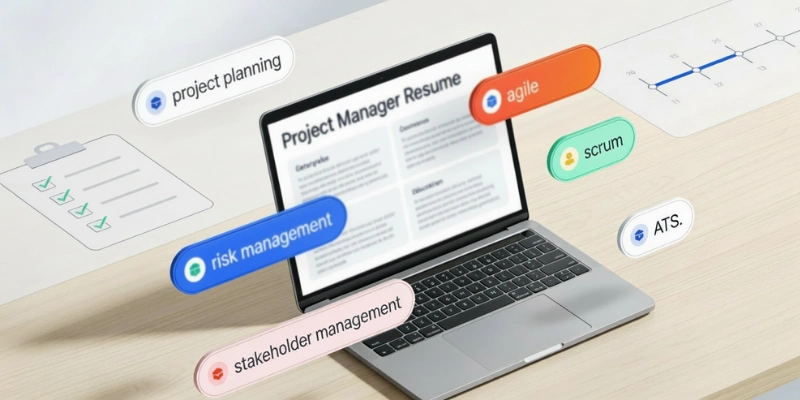
Your resume can be packed with solid project wins and still get ignored if it doesn’t use the same project management keywords employers search for. In 2023, the right keyword choices help your project manager resume match the job description, look more relevant, and move faster through ATS screening.
This post gives you a practical keyword plan, real examples, and a clean way to tailor your resume without sounding like a buzzword machine.
Key takeaways
- Project management keywords work best when they match the job description you’re applying to.
- A few well-placed terms beat stuffing your resume with every buzzword you can find.
- Your work experience bullets should prove the keyword with a deliverable, a metric, or a result.
- Agile and Scrum terms matter in software development, but construction project roles often prioritize cost, safety, and scheduling language.
- Clarity is what helps your resume stand out in 2023.
Resume + project management keyword basics
Project management resume keywords are simply the words employers use to describe the work they need done. When your resume uses those terms, it’s easier for potential employers to see your fit fast. It also helps applicant tracking systems compare your resume to the job description.
A keyword should never sit alone. You want it tied to a real outcome: a deliverable, a schedule improvement, or cost control. That’s how you make your resume feel real instead of “salesy.”
Here’s the mindset shift: project managers aren’t hired for knowing terms. Project managers are hired to get outcomes throughout the project, even when priorities change.
ATS: what it scans for and what it ignores
ATS tools look for matches between your resume and the job description, especially around skills, methodology, tools, and the target industry. Many ATS keyword guides for project roles highlight core terms like scheduling, budgeting, and stakeholder communication as common search targets. That’s why your resume should include a few high-signal phrases that match the role you want.
At the same time, ATS doesn’t “respect” fluffy language. A buzzword like “hard-working” won’t help you. What helps is showing you can manage resource allocation, track project schedules, and protect quality standards.
Keep your formatting simple so the ATS can read it cleanly. Use a clear section header, a normal font, and avoid graphics that can confuse parsing.
Project planning keywords that show control
When employers hire project managers, they want someone who can turn chaos into a plan. That’s why project planning language is such a strong signal. In your resume, “project planning” can show you know how to set the management plan, build a project timeline, and keep work moving through the project lifecycle.
Use planning keywords where you can show ownership. Mention initiation once if you truly drove kickoff and alignment. Mention strategic planning once if you were involved in roadmap-level decisions, not just task lists.
Be careful with vague planning lines like “responsible for project planning.” Instead, show a proof point: “Created and maintained detailed project documentation, defined milestones, and kept deliverables moving across the lifecycle.” That reads like real project management experience.
Risk management keywords that sound credible
Risk management is one of the fastest ways to sound like a real PM—if you use it correctly. Hiring teams want to know you can spot problems early, handle scope changes, and reduce project delays before they turn into missed deadlines. VisualCV’s ATS keyword guidance for project roles calls out risk-related language as a common area employers value.
Don’t just say “risk management.” Explain what you actually did: tracked risks, escalated issues, adjusted project schedules, or rebalanced resource allocation. Then tie it to a metric, even a simple one like “reduced rework” or “improved on-time delivery.”
One strong sentence can cover multiple signals: “Led risk management, managed scope changes, and ensured compliance with internal and external requirements while maintaining project progress.” That’s meaningful without being a wall of text.
Agile, Scrum, and software development keywords
If you’re applying to software development roles, your methodology matters. Employers often search for agile, Scrum, and agile project management because they want a PM who can work within that rhythm. Many project manager keyword lists and resume guides include Agile and Scrum as common terms for project roles.
Only use Scrum terms if you actually worked in that structure. If you ran ceremonies, tracked blockers, and coordinated with cross-functional teams, it’s fair to reference Scrum. If you only attended standups, don’t pretend you owned the process.
A clean way to write it: “Managed a software development project using agile practices, supported Scrum planning, tracked deliverables, and aligned stakeholder expectations.” That shows familiarity with software development without over-claiming.
PMP and certification keywords (when to use them)
If a job posting asks for PMP, include it—exactly as written. If you’ve earned PMP, it’s a valuable keyword and a credibility signal for project management roles. VisualCV also highlights certification-related terms as relevant depending on the role level.
If you don’t have PMP yet, don’t fake it. You can still show strong project management skills through outcomes and process discipline. Use your bullets to show you delivered a project on time and within constraints, tracked project expenses, and met quality standards.
A good compromise line (if accurate) is: “Studying for PMP” or “PMP in progress,” but only when it fits the job description, and you can discuss your timeline.
Entry-level project keywords vs senior project terms
Entry-level project roles are usually about support, coordination, and documentation. Senior project roles are about ownership, trade-offs, and leadership across teams and stakeholders. Your resume should match the level you’re applying for, because hiring managers can spot a mismatch quickly.
For entry-level project applications, emphasize planning and executing basics: project tasks, meeting notes, status updates, and maintaining project trackers. For senior project roles, emphasize governance, stakeholder management, resource allocation decisions, and metric-based performance tracking.
This is where action verbs help. Words like “led,” “owned,” “optimized,” and “delivered” signal seniority, but only if your work experience backs them up with deliverables and results.
Construction project keywords employers expect
A construction project resume should sound different from a software development resume. Construction roles often prioritize safety, scheduling, vendors, inspections, and cost control. You want industry-specific keywords that show you can manage project costs, avoid project delays, and coordinate teams on-site.
Use phrases that connect to real work: project schedules, procurement timing, subcontractor coordination, change orders, and compliance. Even if the posting doesn’t say “stakeholder,” you still have stakeholders—owners, vendors, inspectors, and internal leaders—so you can use stakeholder language when it fits naturally.
If you worked on a construction project delivery, show how you protected the timeline: “Coordinated with cross-functional teams and vendors to keep the project timeline stable, manage project expenses, and hit key milestones.”
Where to place keywords on your resume
Where you place a keyword matters almost as much as which keyword you choose. Put your most important keywords in three places: your headline/summary, your skills section, and your work experience bullets. That makes your resume easier for both ATS and humans to scan.
Start by rewriting your summary line so it fits your target role. Then make sure your bullets prove it with a metric, not just claims. Include one line that references key performance indicators only if you actually tracked them, because that term signals measurement maturity.
Rule of thumb: if the keyword isn’t supported by a result, it’s not doing much for you.
Copy/paste keyword bank (use once, then tailor)
Below is a starter list you can paste into a scratch document and compare against your job description. These terms show up often in project manager resume keyword lists and ATS keyword guidance for project roles:
- project planning
- project timeline
- project lifecycle
- Agile
- Scrum
- risk management
- resource allocation
- stakeholder management
- cross-functional
- deliverable
- project schedules
- project expenses
- microsoft project
Project management buzzwords: what to use, what to skip
Project management buzzwords can help when they are tied to real work. A buzzword becomes useful when it names a real process, tool, or outcome. It becomes useless when it’s just a vibe. Indeed’s list of project management buzzwords includes many common terms people add to resumes, but the best ones are the ones you can prove with results.
Here’s what to use: terms that describe real actions—planning, tracking, optimizing, coordinating, and delivering. Here’s what to skip: empty claims like “detail-oriented” without evidence. Employers are looking for proof that you can manage project scope, protect the schedule, and keep teams aligned.
If you want your resume’s stand-out factor to increase, focus on proof. A project manager who understands what hiring teams care about will use fewer buzzwords and more outcomes.
Frequently Asked Questions
Do keywords really matter for a project manager’s resume?
Yes, because keywords help your resume match the job description and show relevance fast. ATS keyword guidance for project roles often emphasizes core terms like scheduling, budgeting, and risk-related language.
How many keywords should you use?
Keep it natural. Use a few important terms that match the job description, then prove them in your work experience. One strong bullet with a metric can outperform a whole paragraph of buzzword stuffing.
Should you include agile and Scrum on every resume?
No. Use agile and Scrum when the role calls for it (often in software development) and when you can explain your involvement clearly. Many resume guides include these terms because employers search for them, but accuracy matters.
Is PMP worth listing as a keyword?
If you have PMP, list it. If the job posting asks for it, it can be a strong signal for project management roles and senior project manager tracks. ATS keyword guidance for project management roles also notes that certification terms can matter depending on the level.
What if your resume is strong but you’re not getting calls?
Then your resume may be missing the industry-specific keywords the employer is searching for. Tighten your summary, mirror job description terms, and make sure every keyword is supported by a deliverable and results.
Conclusion
Project management resume keywords for 2023 are about being understood quickly. When you match the job description, use a few high-signal terms, and back them up with metrics, you look like a stronger candidate right away. You don’t need every buzzword—you need the right words, placed in the right spots, with proof behind them.
If you want a project manager resume that’s ATS-friendly, human-sounding, and built to win interviews, reach out to Resume Fixer Upper for professional resume writing and career support. You’ll get a resume that highlights your strengths, your deliverables, and your fit for the roles you’re targeting.