
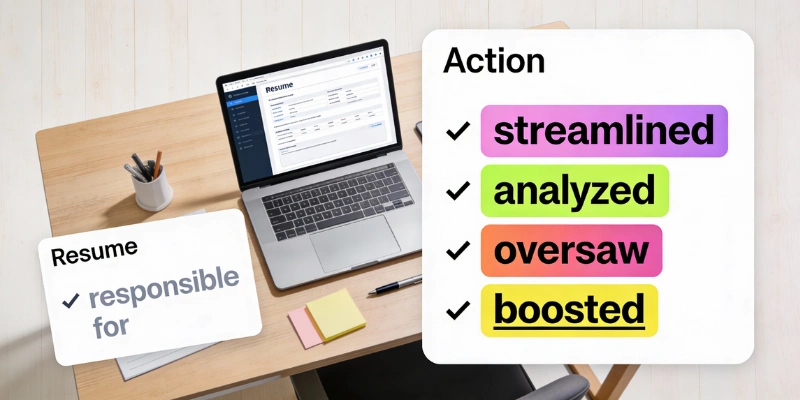
Your resume can be packed with experience and still feel flat if your bullets sound passive. The right action verb turns “job duties” into clear impact, and it helps the employer see what you actually did. This guide gives you a simple system, strong action verbs, and examples you can plug into your resume today.
Key takeaways
- Action verbs help your resume sound confident and focused instead of passive.
- A strong action verb works best when you pair it with a metric or outcome.
- You’ll get better results when you tailor verbs to the job posting and role.
- Avoid repeating the same verbs like “managed” in every bullet.
- Start strong by leading each resume bullet with an action verb.
What is an action verb (and why it works)?
An action verb is a word that shows movement, ownership, and results. It tells the reader you took action, not that work “happened around you.” When recruiters often see vague wording, they skim faster and miss your best work.
A good action verb also creates a clear picture. Instead of “responsible for reports,” you say “analyzed weekly reports and improved accuracy.” That single change makes your resume action feel more real.
You’ll also notice action verbs show confidence without bragging. They keep your writing direct and make it easier for an employer to imagine you in the role.
How do you pick the right action verb?
Start by reading the job posting and circling the skills it repeats. Then pick verbs that match the type of work they need: research, communicate, oversee, streamline, or regulate. This keeps your resume relevant and helps you align your language with what hiring managers want.
Next, choose a verb that matches your level. If you were the owner, use “led,” “directed,” or “orchestrated.” If you supported, use “assisted,” “contributed,” or “supported customers.”
Finally, keep a small “go-to” list for your role. You don’t need 200 action verbs to have a powerful resume, but you do need a few strong action verbs you can rotate so your bullets don’t all start the same. Lists of “185+” and “500+” resume verbs exist, but the best list is the one you actually use well.
Action verbs on your resume: where to use them
The best place for a resume action verb is the start of a resume bullet. That first word sets the tone and helps the reader skim faster. It also forces you to write in active voice instead of passive phrases like “was responsible for.”
Use action verbs in your work experience first, then in projects and internship sections. You can also use them in a summary, but don’t overload your summary with a long listing of words and phrases.
One reminder: a verb without proof is just noise. Pair it with an achievement, result, or metric so it feels impactful.
A quick guide to swapping weak verbs
A lot of resumes rely on the same words, and those words start to blur together. For example, phrases like “managed” and “coordinated” can be fine, but they’re often too broad on their own. Some resume guidance calls out “Managed” and other common verbs as overused because they lose meaning when they show up everywhere.
Here’s a simple swap strategy. Replace “responsible” with a verb that explains the real action, like “streamlined,” “enforced,” “operated,” or “regulated.” Replace “helped” with “supported customers,” “advised,” or “contributed,” depending on what you actually did.
Use this as your mindset: don’t just rename your responsibility—show the action and outcome.
Action verb examples by goal (with a table)
Use this table to choose an action verb based on the result you want to highlight. Then add a metric, time-frame, or scope to make it real.
| What you want to show | Action verbs to use | Strong example phrase |
| Growth or results | boosted, increased, generated, accelerated | like “increased” qualified leads by 22% |
| Efficiency | streamlined, optimized, automated, simplified | increased efficiency by cutting steps from 8 to 5 |
| Leadership | directed, mentored, guided, oversaw | oversee a group project with clear deliverables |
| Research & analysis | analyzed, audited, evaluated, investigated | research trends and turn insights into action |
| Customer impact | resolved, improved, advised, supported | improved customer satisfaction and satisfaction ratings |
These verbs work best when you choose one and write around it. That’s how you showcase skills and achievements instead of dumping buzzwords.
Verbs for research and analysis
If your role involves research, data, or problem-solving, your verbs should show thinking and decision-making. Words like analyzed, validated, audited, and evaluated signal you don’t guess—you measure. That kind of language can help a recruiter see technical expertise even before the interview.
A clean structure is: “researched X, found Y, changed Z.” This makes your bullet feel like a life story, not a task list. It also helps you highlight your skills without sounding vague.
Try adding one metric when you can. Even a simple number (reports per week, datasets reviewed, time saved) turns “research” into a believable achievement.
Verbs that communicate clearly
Communication is one of the easiest skills to claim and one of the hardest skills to prove. Use verbs that show action, not personality. Words like articulated, presented, clarified, and translated show you can communicate across teams.
If you’re writing for leadership, add “briefed” or “advised.” If you’re writing for customers, add “guided” or “supported customers.” If you’re writing for peers, add “collaborated” or “aligned.”
A simple way to strengthen a bullet point is to name the audience. “Presented weekly updates to leaders” reads stronger than “communicated updates.”
Verbs that show you can lead and oversee
Leadership verbs should match your real scope. If you led the work, say you directed, spearheaded, or oversaw it. If you guided people, say you coached, mentored, or trained them.
If your role included enforcing standards, use words like enforce or regulate. Those verbs show trust and ownership, especially in compliance-heavy environments. They also help you sound like someone an employer can hire into a bigger role.
Keep leadership bullets grounded. Leadership without an outcome can feel like a buzzword.
Verbs that increase efficiency (without sounding fake)
Efficiency bullets are common, but many of them are empty. Instead of “improved process,” use a verb that shows what you did: streamlined, simplified, automated, consolidated, or eliminated. Then add the before-and-after when possible.
Here’s a clean pattern: “streamlined X by doing Y, resulting in Z.” It forces you to prove effectiveness instead of just claiming it. That’s how you build a powerful resume.
Also, don’t pretend that every task saved time. Use efficiency verbs when you have real evidence, even if it’s small.
Customer satisfaction and customer service verbs
Customer service bullets should show outcomes, not smiles. Use verbs like resolved, de-escalated, advised, retained, and improved. Then connect them to customer satisfaction, retention, or response time.
If you work with customer satisfaction metrics, name them. “Improved satisfaction ratings from 4.1 to 4.6” is stronger than “provided great service.” If you don’t have scores, use volume (tickets handled) or speed (time to resolution).
These verbs help you sound like a problem-solver instead of a passive helper. They also make your resume feel more confident to a recruiter.
Internship and entry-level action verbs
If you have an internship, don’t undersell it with weak verbs like “helped.” You can still show impact with verbs like contributed, assisted, supported, compiled, documented, and coordinated.
Entry-level bullets work best when they show learning plus output. For example: “researched competitors and summarized findings for weekly planning.” That shows you did real work, not just shadowing.
Also, name tools or systems when relevant. It helps the employer see you’re ready to operate in a real workflow.
One bullet list of action verbs to use
Use this as your starter kit. Pick a few action verbs you can use, then tailor them to the job description.
- Analyzed (research and decisions)
- Streamlined (process and efficiency)
- Orchestrated (cross-functional delivery)
- Advised (guidance and expertise)
- Enforced (standards and compliance)
- Regulated (policy and controls)
- Navigated (change and complexity)
- Contributed (team outcomes)
- Supported customers (service and retention)
- Oversaw (leadership and ownership)
You don’t need every word here. You need the ones that match your real work.
How to edit your resume bullets fast
Do a quick scan for passive language. If you find “responsible for,” rewrite it. If you start five bullets with the same verb, swap two of them for a synonym that better describes the action.
Also, check that every bullet has a clear action plus a result. If it’s missing a result, add a metric, a scope number, or a clear outcome. This is where many resume bullet points get weak: they list tasks, but they don’t show achievements.
Small swaps can make your resume stand out without rewriting the whole document.
Frequently Asked Questions
How many action verbs should you use on a resume?
Use one action verb per bullet, and rotate your verbs so your resume doesn’t sound repetitive. Focus on quality and proof over quantity.
Are action verbs really that important?
Yes, because they quickly show what you did and how you added value. They also help your bullets sound active instead of passive.
Should you avoid words like “managed” and “coordinated”?
Not always, but don’t lean on them for everything. Some resume guidance lists “Managed” as an overused verb, so it helps to be more specific when you can.
What’s the best way to prove an action verb?
Add a result. Use numbers, a time-frame, a scope, or a clear outcome so your action verb doesn’t read like a buzzword.
Can action verbs help you get an interview?
They can, because they make your resume easier to skim and easier to believe. Clear writing helps a recruiter quickly see why they should move you forward.
Conclusion
Action verbs don’t replace experience, but they make your experience easier to understand. When you choose the right verb, pair it with an outcome, and tailor it to the job posting, your resume becomes more direct, more confident, and more likely to get noticed. A great cover letter can help, but your resume still needs to carry the first scan.
If you want help turning your job duties into strong, clean bullets that get interviews, reach out to Resume Fixer Upper for professional resume writing and career services. You’ll get a resume that reads like a real person did real work—and knows how to show it.