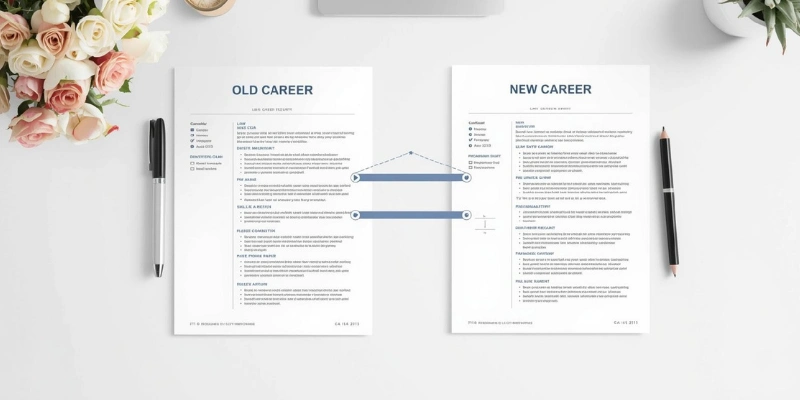
A career change resume helps you connect your past experience to a new career without sounding like a stretch. You’re not trying to erase your old career—you’re trying to show an employer why you’re the right person for the job in a new field.
In this guide, you’ll learn how to write a career change resume that feels clear, honest, and confident. You’ll also get a simple template you can follow and real ways to highlight what matters most.
Key takeaways
- If you’re changing careers, your resume must make the connection for the hiring manager.
- Start by highlighting transferable skills and then back them up in your work experience.
- A hybrid resume often works well because it blends skills-first with a clear job history.
- Use the job description to pick the right keyword choices and tailor your resume.
- A great cover letter can support your career transition, but your resume still needs to do the heavy lifting.
Career change resume: what makes it different?
A career change resume is a resume that’s built for a new field, not your old career. That means your top half should focus on what’s relevant to the new career, even if your job history doesn’t “look perfect” at first glance. Some career advice recommends leading with a personal statement/summary and showcasing skills earlier when switching careers.
Your biggest job is to guide the reader. You want them to see your strengths fast, not get stuck wondering why you’re making the change.
Make the connection obvious. Don’t hope the employer figures it out on their own.
What job title should you use when switching careers?
Your job title is one of the first things a recruiter sees. For a resume for a career change, use a headline that matches the role you want, not the role you had.
Try a simple format like: “Target Role | 2–3 Strengths | Industry Focus.” This helps you highlight your direction without pretending you already held the new job title.
Example: “Project Coordinator | Stakeholder Support | Process Improvement.” That reads clean, and it still stays truthful.
How do you find transferable skills that matter?
Transferable skills are the skills that move with you from one career path to another. Think communication, problem-solving, planning, training, reporting, customer support, or leadership.
Here’s the trick: don’t list 20 skills. Pick the transferable skills that match the job description and prove them with results. That’s how you highlight what you can do, not just what you’ve “been around.”
To find the right transferable skills you bring, scan the posting for repeated words. Then match each one to a real example from your past experience.
Best resume formats for career changers
Career changers often do best with a hybrid resume (also called a combination format). It lets you highlight transferable skills near the top, while still keeping a clear work history.
A chronological format can still work if your past experience is closely related to the new field. If you’re making a bigger career switch, chronological alone can bury your best selling points.
Use a format that helps the hiring manager see your strengths in the first few seconds. That’s the whole point of choosing the right resume formats.
How to write a resume summary for a new field
Your resume summary is where you explain your direction in a confident way. Keep it short, specific, and focused on the new career.
A strong resume summary answers three questions:
- Who are you (professionally)?
- What new field are you moving into?
- What skills and experience make you a fit?
Some guidance for switching careers suggests starting with a personal statement that shares your goals and connects your past experience to the new industry.
Use clear language. Avoid buzzwords that don’t prove anything.
Work experience: how to reframe past experience
Your work experience doesn’t need to match the new field perfectly. It needs to be relevant to the new role.
Start by rewriting your bullet points so they highlight what transfers. For example, if you managed schedules, budgets, vendors, or stakeholders, those are valuable in many roles.
Here’s a table to help you translate your old career into a new path:
| If you did this before | It can translate to this | What to write on your resume |
| Trained new staff | Coaching + onboarding | “Trained 6 new hires; improved ramp-up time.” |
| Built reports | Analysis + decision support | “Created weekly reports used for planning.” |
| Managed customer issues | Service + problem-solving | “Resolved escalations and improved satisfaction.” |
| Coordinated projects | Project coordination | “Tracked tasks and deadlines across a team.” |
When you do this well, you highlight the parts of your past experience that are directly useful now.
Certification, coursework, and projects for a new path
If you don’t have direct work experience in the new field yet, add proof in other ways. Certification and coursework can help show commitment and job-ready knowledge, especially if it’s relevant to the new career.
Projects matter too. A project can be a class project, a volunteer effort, or a personal build. It gives you something real to talk about and a way to show hands-on ability.
If you’re changing careers into a technical area, include technical skills you’ve learned and how you’ve used them. If you’re moving into people-focused work, highlight soft skills with real outcomes.
ATS and keywords: how to tailor your resume
An applicant tracking system (ATS) can screen you out before a human sees your resume. That’s why you want to tailor your resume with the right keyword choices from the job description. Guidance on career-change resumes commonly emphasizes including relevant keywords and tailoring each application.
Don’t do keyword stuffing. Use the keyword where it fits naturally, then support it with proof in your bullet points.
Here’s one set of bullet points you can use as a quick “tailor checklist” (and yes, keep it to one set so it stays clean):
- Match your resume headline to the job title you’re applying for.
- Mirror 6–10 key terms from the job description in your skills section.
- Update your resume bullets to show results tied to those terms.
- Remove anything not relevant to the new field.
Tailor smart, not loud. You want to sound like a real person, not a keyword list.
Cover letter: should you explain the career switch?
Often, yes. A cover letter gives you room to explain your “why” in a calm, positive way. It can also help if you’re making a career change resume that needs context.
Keep it simple:
- Why you’re changing careers
- Why this new field fits you
- Proof you can do the job (transferable skills + results)
Some career advice on switching careers recommends using the opening to explain your goals and how your previous experience transfers.
A cover letter should support your resume, not repeat it. Use it to connect the dots.
Mistakes career changers should avoid
A few mistakes can make an employer nervous—even when you’re fully capable.
First, don’t hide the career transition. Say it clearly in your resume summary and show the logic. Second, don’t keep every bullet from your old career. You should highlight what’s relevant to the new field and cut the rest.
Third, don’t overload your resume with certification lists. One or two strong items plus proof is better than a long scroll.
Finally, don’t forget to update your resume for every application. When you tailor each version, you make it easier for the hiring manager to see you as the right resume match.
Frequently Asked Questions
What is a career change resume?
A career change resume is a resume that’s written to support a move into a new field. It focuses on transferable skills and relevant proof, even if your past job titles don’t match.
What’s the best resume format for changing careers?
Many career changers do well with a hybrid resume because it lets you lead with skills and still show your work history.
How do you highlight transferable skills without sounding vague?
Pick a transferable skill, then prove it with a result. For example: “Led training,” then add scope and outcome.
Do you need a cover letter for a career transition?
A cover letter can help because it explains the “why” behind your career switch and supports your resume story.
How many certifications should you include?
Only the certifications that are relevant to the job. If it doesn’t support the new career, leave it out.
Conclusion
When you’re making a career change, your resume needs to do two things at once: show your value and explain your direction. The best career change resume highlights transferable skills, backs them up with results, and stays focused on what’s relevant to the new career. If you write a career change resume with a clean format, the right keywords, and strong proof, you can compete even without “perfect” job titles.
Reach out to Resume Fixer Upper if you want help writing a career change resume that feels natural, focused, and tailored to your new field. You’ll get expert resume writing support, a strong cover letter if you need it, and a clear plan to update your resume for the jobs you actually want.