
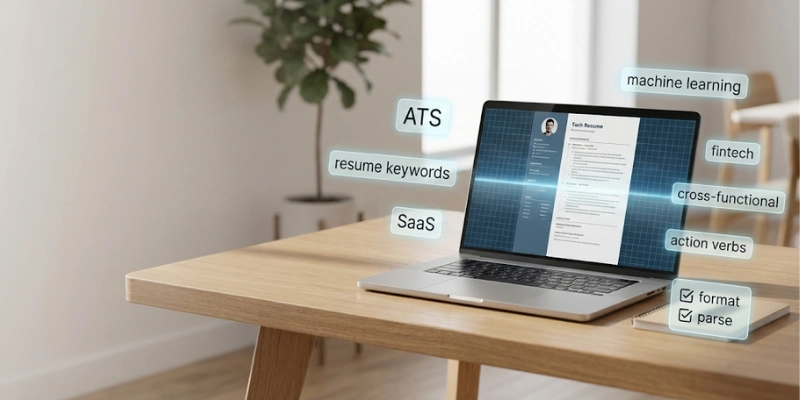
Tech recruiters and ATS screenings won’t “guess” what you meant—your resume has to spell it out with the right keyword choices, clear job titles, and proof in every bullet point. If you want to get noticed, you need resume keywords that match the job description and a format that can be parsed cleanly.
This guide shows you how to tailor, place, and prove the relevant keywords tech companies look for—without keyword stuffing.
Key takeaways
- Match your resume keywords to the exact words and phrases listed in the job description.
- Keep your format simple, so applicant tracking systems can parse your resume correctly.
- Put hard skills in a skill section, then prove them in work experience bullets.
- Use action verbs to start each bullet point (Jobscan publishes 500+ options).
- Put your professional brand on your LinkedIn profile, not inside fancy resume graphics.
Resume keywords: why tech is different
In tech, the recruiter is often looking for specific keywords fast: languages, frameworks, cloud platforms, databases, and systems. If your resume is missing those key words, you can be a qualified candidate and still get filtered out during the hiring process.
You also have to balance two audiences: recruiters and ATS. Recruiters want a clean story they can skim, and applicant tracking systems want consistent words and phrases they can match to the job posting.
That’s why “I worked on a scalable system” isn’t enough. You need the tech stack plus the impact, in plain language.
ATS-friendly format: what parses cleanly?
An ATS-friendly resume is usually simple: one column, standard headings, and no design tricks. If the system can’t parse your content, your skills or experiences can land in the wrong place—or disappear.
Avoid graphics, icons, and heavy design elements. Advice for ATS-focused resumes commonly warns that images can cause problems for ATS readability and screening.
Here’s the cleanest approach: make your resume easy to scan, then make it easy to prove.
Skill section: hard skills vs soft skills
Your skill section should be the “menu,” and your work experience should be the “proof.” Put technical skills (your hard skills) in a tight list that mirrors the job description.
Then add soft skills carefully. Soft skills like communication skills and management skills matter, but they only work when you show them through results.
Example: instead of saying “cross-functional,” show it. “Coordinated cross-functional releases with Product and QA; reduced cycle time by 12%.” That’s a soft skill with proof.
Job title alignment: are you matching the posting?
Job title mismatch is a common problem in engineering roles. If the job description says “Backend Engineer” and your resume headline says “Software Developer,” you may still fit—but you just made the recruiter work harder.
You don’t need to change your official job title. But you can add a clarifier in parentheses to match the type of position.
Example: “Software Engineer (Backend)” or “Full Stack Engineer (React/Node).” This helps recruiters and ATS connect you to the role faster.
Software engineer resume keywords (by specialty)
A software engineer’s resume should reflect their actual lane. Pick keywords based on what you want to be hired to do next, not everything you’ve ever touched.
Use this table to choose relevant keywords by target role:
| Specialty | Specific keywords to consider | Proof to add in bullets |
| Backend | APIs, microservices, REST, SQL, caching, queues | Latency, throughput, error rate, cost |
| Frontend | React, TypeScript, accessibility, performance | Conversion, load time, UX metrics |
| DevOps/SRE | CI/CD, IaC, observability, incident response | Uptime, MTTR, deployment frequency |
| Data/Analytics | ETL, data pipelines, dashboards, BI, SQL | Data accuracy, refresh time, adoption |
| Security | IAM, threat modeling, vulnerability mgmt | Findings closed, risk reduced |
Keep it honest. The fastest way to fail an interview process is to list keywords you can’t explain to an interviewer.
Machine learning keywords that hiring managers scan for
Machine learning roles often fail at the keyword level because candidates stay too academic. If you worked in ML, don’t just say “machine learning.” Name the type of ML work you did and how it shipped.
Good ML keyword examples include: feature engineering, model training, evaluation, inference, monitoring, and drift. Then add your stack: Python, notebooks, pipelines, and deployment workflow.
Also include the business outcome. Hiring managers want to hire people who can ship models, not just experiment.
Bullet point keywords: where to place proof
A bullet point should start with a strong verb, then the tool/skill, then the result. Jobscan maintains a list of 500+ action verbs you can use to make bullets more direct and readable.
This is also where you avoid keyword stuffing. Stuffing looks like a long list of tools with no impact. Proof looks like “streamlined CI/CD to reduce deployment time from 30 minutes to 10.”
Use this quick pattern:
Verb + what you built + tech + result
And keep it tight. A recruiter should be able to scan your resume and understand the impact in seconds.
Buzzword vs keyword: what’s the difference?
A buzzword is vague and hard to prove. A keyword is specific and searchable.
“Scalable” can be a buzzword if you don’t explain scale. “Scalable (handled 2M requests/day)” becomes proof. Same word, different credibility.
If you want a good resume, cut the fluff. Use keywords that match the job description, then back them up with numbers, scope, and outcomes.
Cover letter keywords: do they matter in tech?
A cover letter can help in some technical roles, but it won’t rescue a weak resume. Use the cover letter to connect your experience to the role, explain a shift (like fintech to SaaS), or address something that needs context.
Keep your cover letter aligned with the same keywords on your resume. If your resume says “data pipelines” and your cover letter says “data workflows,” that’s fine—those can be synonyms—but don’t drift into totally different language.
Your job application should feel consistent across resume, cover letter, and LinkedIn.
Using AI to tailor your resume (without sounding fake)
Using AI can speed up customizing your resume, but you still need to sound like you. The safest method is to use it for organizing: extracting key phrases from the job posting, comparing them to your resume, and spotting missing skills or experiences.
Then you rewrite in your own voice. Keep phrases short, concrete, and tied to real work experience.
One more warning: don’t let AI “inflate” your background. ATS might pass you, but the interviewer will catch it.
Frequently Asked Questions
How many keywords should you put on a tech resume?
Enough to match the job description naturally. If you’re repeating the same keyword in every bullet, that’s usually too much.
What’s the best ATS-friendly resume format?
A simple format that parses cleanly: one column, clear headings, and no graphics. ATS parsing issues are a known problem when resumes use complex design elements.
Should you paste the entire job description into your resume?
No. That’s keyword stuffing, and it reads poorly. Use the terms listed in the job description, but only where they match your real skills and achievements.
Is it okay to tailor your resume for every job?
Yes—tailor your resume for every serious application. It’s one of the most effective ways to match the job and get noticed.
Do action verbs matter for technical roles?
Yes. Action verbs make your bullet point clearer and more direct, and there are large curated lists (500+) specifically for resumes.
Conclusion
If you want to get hired in tech, your resume needs more than good experience—it needs the right keyword strategy. Match the job description, keep an ATS-friendly format, choose relevant keywords for your specialty, and prove them in strong bullet points. Do that, and you’ll make it easier for recruiters and hiring managers to see you as the ideal candidate.
Reach out to Resume Fixer Upper if you want a resume review service that turns your experience into a clear, keyword-smart, interview-ready resume—plus a cover letter and LinkedIn profile that work together to help you land the right role.