
If you’re applying for a job, you’ve probably wondered whether you need a resume or a CV. The short answer: most people in the U.S. need a resume, while a CV (curriculum vitae) is usually for academic, research, and certain medical or teaching roles.
This article is worth reading because choosing the wrong document can slow down your job application, even if your skills are strong.
Key takeaways
- A resume is a concise document that highlights your experience and skills for a specific position.
- A CV is a comprehensive document that lists your full academic and professional background (often used for research positions and teaching experience).
- In the U.S., “resume vs CV” usually means: resume for most jobs, CV for academia and research-heavy paths.
- If a job posting says “CV,” don’t guess—follow the preferred format and tailor your CV to the role.
- If you’re unsure, a good rule is: industry job = resume, academic job = CV.
Resume vs CV: what’s the difference?
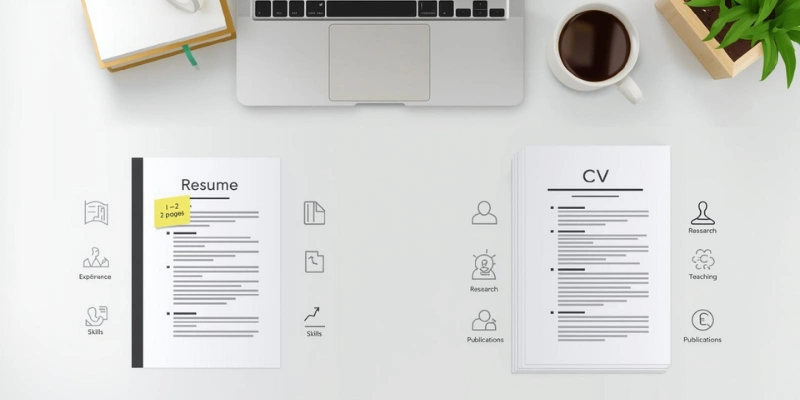
The difference between a CV and a resume comes down to purpose and depth. A resume is built to summarize what’s most relevant to the job you’re applying for, so it stays concise.
A CV (the term CV is short for curriculum vitae) is designed to document your full academic path. That includes research experience, publications, teaching experience, grants, presentations, and affiliations.
In other words, resume vs. CV isn’t about which one is “better.” They’re used for different purposes.
What is a resume in the U.S.?
In the U.S., a resume is a brief, targeted summary of your experience and skills. It’s written for a specific job application, which is why tailoring matters.
A traditional resume is built around relevant work experience, key skills, and accomplishments. Most resume formats put work experience in reverse-chronological order so a hiring manager can scan your recent roles fast.
If you’re a job seeker, your resume should make your qualifications obvious without making the reader work for it.
What is a CV (curriculum vitae)?
A CV is a comprehensive document that lays out your full academic and professional history. It often includes sections for research positions, academic achievements, teaching experience, and professional affiliations.
This is why a CV is longer than a resume in most cases. You’re not trying to summarize; you’re documenting your career path in detail.
If you need a CV, you’ll usually know it because the role will ask you to send a CV (or it will be standard practice in that field).
CV vs resume: key differences
Here are the key differences between a resume and a CV in a simple view.
| Category | Resume | CV |
| Main goal | Summarize qualifications for a specific role | Provide a full record of academic/professional work |
| Length | Often one to two pages | Often longer; CV is typically multiple pages |
| Best for | Most job seekers and industry roles | Academia, research positions, grants, teaching |
| Focus | Relevant work experience + results | Research experience + publications + affiliations |
| Customization | Tailor your resume to each job posting | Tailor your CV to the role, but keep your full history |
If you’re stuck between a CV and a resume, use the job posting language as your deciding factor.
CV or resume: which do you need?
You need a resume for most jobs in business, tech, operations, sales, customer service, and management. You usually submit a resume because the employer wants to compare candidates quickly.
You need a CV for many academic roles, research-heavy roles, and some medical paths where publications, training, and teaching experience matter. This is common when the potential employer needs a deeper review of your background.
If the posting uses “CV and resume” interchangeably, don’t panic. Some employers use the terms loosely, especially outside the U.S., so check the context and the requested sections.
When do you need a CV over a resume?
You may need a CV over a resume when the hiring process is centered on academic achievements and research output. That includes research positions, grant-funded programs, and some roles connected to universities or labs.
A CV is also common when teaching experience is a core qualification. In those cases, a resume might feel too thin because it can’t show the full story.
If you’re applying internationally, keep in mind that “CV” can be used interchangeably with resume in some regions. In the U.S., the difference is usually sharper.
How do you write a CV?
To write a CV, start by listing your contact information, then build sections that match your field. A strong CV often includes education, research experience, teaching experience, publications, presentations, awards, and affiliations.
Keep your CV format easy to read. Use clear headings, consistent dates, and short descriptions that explain your role and outcomes.
Most importantly, keep it accurate. A CV is detailed by nature, so small errors (like incorrect dates or titles) can weaken trust fast.
How do you tailor your resume or CV?
Tailoring is what turns a “general” document into one that fits a specific position. For a resume, tailoring usually means editing your professional summary, skills, and bullet points to match the job description.
For a CV, tailoring often means reordering sections and emphasizing what’s relevant to the new role (for example, putting research experience and publications near the top for a research position). You can also trim less relevant details so your strongest material is easier to find.
One extra tip: if you’re applying through an ATS, avoid fancy layouts. Some ATS tools can struggle with complex formatting like tables and columns, which can lead to parsing issues.
But what about cover letters- need one?
Sometimes you do. A cover letter can help you connect your experience and skills to the role, especially if you’re changing fields or applying to a competitive program.
A cover letter should not repeat your resume or CV. It should explain fit, motivation, and a few standout points that make you worth an interview.
If the posting says “optional,” it’s still worth sending a cover letter when you have a clear story. If you don’t, focus on making the resume or CV stronger first.
Frequently Asked Questions
What’s the difference between a CV and a resume?
The main difference between a CV and a resume is depth. A resume summarizes what’s relevant to a job, while a CV documents a fuller academic and professional record (often including research and teaching).
Is a CV and a resume the same thing?
Not in the U.S., usually. In the U.S., CV and resume are used for different purposes, even though some countries use the terms interchangeably.
Do you need a CV for a normal job application?
Most of the time, no. Most standard job application postings want a resume, not a CV.
How do you know whether to submit a resume or a CV?
Follow the job posting instructions. If it asks for a CV, submit a CV; if it asks for a resume, submit a resume.
Can you use the same document for every job?
You can keep a base version, but you should tailor your resume (and tailor your CV when needed) so it’s relevant to the job you’re applying for.
Conclusion
CV vs resume isn’t confusing now that you know the purpose of each. A resume is a concise document built for most jobs, while a CV is a comprehensive record used more often in academia, teaching, and research positions. The right choice depends on what the employer asks for and what the role needs.
If you want help deciding whether you need a resume or CV—and you want a document that fits the job, sounds like you, and gets you considered for an interview—reach out to Resume Fixer Upper for professional resume writing, CV support, and career services.