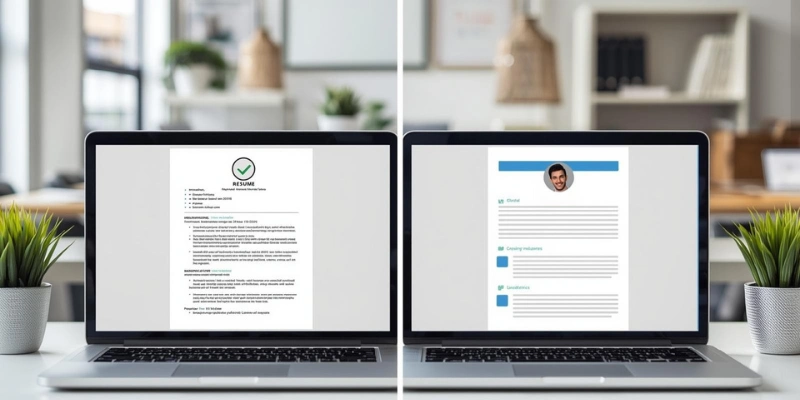
In the US, you should usually not put a photo on your resume. Many employers avoid resume photos to reduce the risk of bias and to stay aligned with anti-discrimination laws, and some recruiters may reject resumes with images.
This guide gives you clear rules for when a photo on your resume hurts, when a photo is appropriate, and what to do instead so you still make a strong first impression.
Key takeaways
- In the US, standard practice is to keep a resume text-only and skip a headshot.
- A resume photo can increase unconscious bias and create legal risk for employers under anti-discrimination laws.
- Graphics (including pictures) can also cause applicant tracking system parsing issues, so your resume could lose important text.
- Put your professional photo on LinkedIn instead of including it on your resume.
- Only include your photo when the employer explicitly asks for it (such as in some acting or modeling roles).
Photo on your resume: what US employers expect
In the US, a resume is meant to highlight your qualifications, skills, experience, and results—not your appearance. Career guidance commonly recommends leaving a photo off your resume because it’s considered unprofessional to include one in many US hiring settings.
This is why you’ll hear “photo off your resume” advice so often. It’s not personal. It’s about reducing risk and keeping the hiring process focused on what matters.
If you want your resume to feel modern, keep it clean, clear, and text-first. In most industries, that is the professional resume standard practice.
Why do recruiters avoid resume photos?
A photo can reveal information like your age, race, gender, and other traits that can trigger unconscious bias. That creates risk for both the employer and the applicant, especially under anti-discrimination laws and common hiring practices in the US.
Because of this, some recruiters choose to avoid photos entirely, and some teams have policies that prohibit considering resumes with images. Even if you mean well, the inclusion of a photo can push attention toward appearance instead of your experience and skills.
That’s why, in the US job market, a picture on your resume could backfire even when the photo looks professional.
Does a photo help you hire faster?
In most US hiring workflows, a photo doesn’t improve your chances of getting hired. Your resume could become harder to evaluate fairly, and the reader may focus on the wrong thing.
A photo may also distract from the parts that actually help you get hired: strong bullets, results, and clear skills. Your first impression should come from impact, not a headshot.
So while you might think a photo helps you stand out, the safer move is to stand out with content.
When is a resume photo appropriate in the US?
There are exceptions. If you’re an actor, a model, or an actor in a visual industry, or the job application specifically requests a headshot, follow the employer’s instructions. In those cases, it’s often better to submit a headshot as a separate file or as part of a portfolio, not embedded in the resume.
Also, some public-facing roles may expect photos in certain countries, like parts of Europe, but the US is different. If you’re applying for a position in the US, your default should be no photo unless you’re applying to a role where appearance is relevant, and the employer asks.
If you’re unsure, re-read the job posting. If it doesn’t ask, don’t add it.
When can a picture on your resume hurt ATS?
An applicant tracking system is built to read text and organize it into fields. Images, icons, and complex designs can disrupt parsing, which means the ATS may miss your name, job titles, or keywords.
Even if your resume looks nice to you, ATS can “see” it differently. Some ATS guidance warns that graphics and images can interfere with reading order and cause missed keywords. That’s a big risk when you’re trying to get through early screening.
Bottom line: if the ATS can’t read it, it can’t score it, and your resume might get filtered out.
Photo on LinkedIn vs photo on a resume
A photo on LinkedIn is normal. LinkedIn is designed for professional photos, and it has a clear spot for a headshot. That’s why “put your photo on LinkedIn” is usually the best move instead of including it on the resume.
Here’s the win: you keep your resume clean for ATS and HR, while still letting hiring teams see a professional photo if they choose to view your profile. Your LinkedIn profile can support your personal brand without putting you at risk during resume screening.
If you want a professional headshot, update LinkedIn and keep your resume text-first.
How to make a standout resume without a photo
If you want a standout resume, focus on the sections that actually drive interviews:
- A sharp headline and summary that matches the role
- Strong experience bullets with results
- Skills that match the job description
- Clean formatting and consistent spacing
You can also add credibility without a picture by including certifications, awards, portfolios, or a LinkedIn URL. That gives the employer more proof without pushing appearance into the hiring process.
Your resume picture is your proof: metrics, outcomes, and clear writing.
If you must add a photo, do it professionally
If you’re in one of the rare cases where a resume photo is appropriate, don’t use a selfie. Use a professional photo (or at least a professional headshot style image), good lighting, and a neutral background. A selfie can look unprofessional and distract from the rest of your resume.
Keep the photo small, and don’t crowd out your contact information. Make sure the file still exports cleanly and doesn’t break ATS readability.
Also, avoid using a photo on my resume as a “design feature.” The photo should never be the main event.
What to do for global job applications
If you’re applying outside the US, expectations change. Some regions may treat pictures on resumes as normal, while the US and UK often discourage them. That’s why you should tailor your resume to the region, not just the role.
If you’re applying globally, keep two versions: one US-style resume (no photo) and one region-specific version if the target country expects it. This is one of the simplest ways to avoid confusion and protect your chances.
Quick decision table before you submit your resume
| Situation | Put a photo on your resume? | Why |
| Applying in the US (most roles) | No | Bias/legal risk + not standard practice. |
| The job posting asks for a headshot | Yes (usually separate) | Follow instructions; often portfolio-style. |
| Acting/modeling | Yes (common) | Appearance can be relevant to the job. |
| You want a stronger first impression | No | Use LinkedIn photo instead. |
| You’re applying through ATS | No | Images can cause parsing issues. |
Frequently Asked Questions
Is it unprofessional to include a picture on your resume in the US?
Often, yes. Many US employers prefer a text-only resume and may avoid resumes with photos to reduce bias and legal exposure.
Can a resume photo hurt your chances of getting hired?
It can. A photo may trigger unconscious bias concerns and may even lead to automatic rejection at some companies.
What should you do instead of including a photo?
Put a professional photo on LinkedIn and include your LinkedIn URL on your resume. That keeps your resume ATS-friendly while still letting employers see your professional headshot if they look you up.
What if you’re applying for a job outside the US?
Tailor to the country. In some countries, photos are more common, but in the US, they are strongly discouraged.
Should you put a photo on your cover letter?
Usually no. If a headshot is required, follow the employer’s instructions and submit the photo with your job application the way they request it.
Conclusion
In the US, putting a photo on a resume is usually the wrong move. It can create bias concerns, complicate the hiring process, and even interfere with the applicant tracking system’s readability. The safest strategy is a clean, text-only resume plus a strong LinkedIn photo.
Want your resume to look modern, professional, and built for US hiring? Reach out to Resume Fixer Upper for expert resume writing help, cover letter support, and career advice that fits the US job market—so you can submit your resume with confidence and get hired faster.