
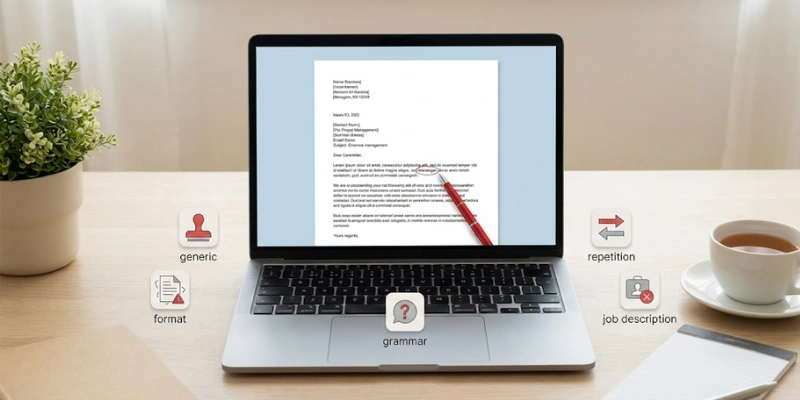
A cover letter can be your first impression before a hiring manager ever opens your resume. It’s also where you can show genuine interest, connect the dots, and prove you’re a great fit for a specific role. This guide breaks down the top 5 mistakes that quietly sink job applications—and shows you how to fix them fast.
One writing principle stays true across professional platforms: keep your message clear, skimmable, and easy to understand.
Key takeaways
- Don’t send a generic cover letter; tailor it to the job posting and employer.
- Address the right person and show that you did the work of researching the company.
- Use specific examples that demonstrate impact, not empty claims.
- Avoid repetition by adding context that your resume can’t cover.
- Proofread for every typo, spelling slip, and formatting error before you submit.
Why a cover letter is still worth your time
A cover letter is an essential part of the job search process when the employer asks for it. It helps you showcase more than titles and dates. It’s your chance to convey why you want to work for that specific company, not just any job.
A recruiter may only spend a short time reviewing job seekers, so your message has to land quickly. Your goal is to make your cover letter concise and to the point, while still sounding like a personal letter. Clarity wins.
Mistake 1: Using a generic template
The most common mistake is sending a generic cover letter that could fit any workplace. Hiring managers can tell when you used a template and swapped in a company name. It reads like you didn’t care, and it makes you look like every other applicant.
Never send a generic cover letter when the posting is asking for a “why us” story. If you’re using a generic approach, you’re forcing the reader to guess how you align with their specific requirements. A great opportunity can disappear because the letter felt lazy.
Fix it by tailoring three things: the opening line, the proof, and the close. Add one sentence about the specific company and one sentence about how your experience solves what they’re looking for.
Mistake 2: Not addressing the hiring manager
Addressing the hiring manager matters because it shows effort and attention to detail. If you can find the hiring manager’s name, use it; using “To Whom It May Concern” often feels dated and cold. Include the hiring manager’s name when possible, even if it takes a few minutes to look.
If you can’t find a name, be specific anyway. “Dear Hiring Team” is better than a vague greeting because it still feels professional. Avoid sounding informal, even if the company culture seems relaxed.
The fix is simple: treat the greeting like part of your brand. It signals professionalism before the reader hits your first paragraph. Respect is a strong first impression.
Mistake 3: Missing the job description and required skills
A cover letter should connect directly to the job description. If you ignore it, you risk talking about the wrong strengths and missing the required skills entirely. That’s a fast way for hiring managers to move on to the next applicant.
Read the job posting and underline the themes: leadership, analytics, customer experience, machine learning, or whatever shows up often. Then highlight 2–3 skills and experiences that match those themes and use the same wording where it makes sense. Use one keyword naturally so it’s clear you’re targeting the target role.
This is where you stop writing “about you” and start writing “for them.” When you align your letter to what they’re looking for, you look like a perfect fit instead of a random job seeker.
Mistake 4: Repeating your resume instead of adding value
Repetition is a silent killer. If your cover letter just restates information from your resume, it adds no value. Your resume already lists roles; your letter should explain meaning, growth, and fit.
Instead of repeating bullets, add context. Explain the “why,” the “how,” and the impact behind one accomplishment. Use one story that shows you’re the ideal candidate, and keep it grounded in real outcomes.
Here’s what to do: pick one project or win and write three lines—challenge, action, result. Keep it tight. Make your cover letter do something your resume can’t: build trust.
Mistake 5: Grammatical errors, bad format, and sloppy details
A single typo can make a hiring manager question your attention to detail. Grammatical errors can also make your message harder to read, and that hurts your first impression. This mistake is painful because it’s preventable.
Watch for the small stuff: spelling, punctuation, and the “wrong company name” error. Keep the format clean with consistent spacing, a readable font, and a clear structure. Don’t try to be fancy—be easy to read.
Proofread twice. Then proofread again after a break. If possible, ask someone else to scan it, because your brain will skip errors you’ve seen too many times.
How to use AI without a “robot” cover letter
AI can help you get started, but it can also create a boring cover letter that sounds like everyone else. The risk is that the letter feels polished but empty, full of corporate lines and no real meaning. If you use AI, treat it like a draft partner, not the final writer.
Use it for structure, then rewrite in your voice. Add specific examples, real numbers, and details that could only be yours. Cut the fluff, delete the cliché lines, and replace them with proof.
One simple test: if the letter could be copied and pasted by another applicant without changes, it’s too generic. Your goal is original and specific.
How to align with LinkedIn and your resume
Your cover letter and LinkedIn should tell the same story as your resume. If your LinkedIn says you’re a strategist, but your resume reads like an executor, hiring teams may doubt your positioning. Keep your messaging aligned: job title, target role, and key strengths.
This doesn’t mean copying text. It means matching the “truth.” If you claim leadership in the cover letter, your resume should show leadership in your work history. If you claim analytics strength, your resume should show results.
Also, don’t over-focus on LinkedIn in the letter. A brief mention is fine if it fits, but the letter should stand on its own.
Quick self-check table before you submit
Use this once before you submit your job applications. It catches the most common cover letter mistakes without overthinking.
| Check | What to look for | Quick fix |
| Personalization | Does it mention the specific role and employer? | Add 2 lines showing fit and interest |
| Proof | Do you show one accomplishment with impact? | Add challenge-action-result in 3 lines |
| Match | Does it reflect the job posting language? | Mirror key terms from the posting |
| Clean writing | Any error, typo, or awkward line? | Read aloud, then tighten wording |
| Professional tone | Anything too informal or too stiff? | Make it direct and human |
A short “great cover letter” structure you can craft
If you want a simple structure you can use for writing a cover letter, follow this flow. It’s fast, clean, and keeps you focused on what matters. This is also how writing cover letters gets easier over time.
Paragraph 1: who you are, the role, and why you’re applying for a position. Mention the role, and add one line that shows genuine interest.
Paragraph 2: your strongest matching example. Use specific examples that demonstrate the skills they’re looking for, and tie them to results.
Paragraph 3: why you fit their team and what you want next. Keep it confident, not desperate, and end with a clear ask to discuss next steps.
Important: follow directions in the job posting. If they ask for a salary range, address the salary briefly and professionally instead of ignoring it.
Frequently Asked Questions
Do you still need a cover letter today?
If the employer requests it, yes. A cover letter can help you stand out by adding context and showing fit, especially when your resume alone doesn’t tell the full story.
What’s the biggest common cover letter mistake?
Sending a generic cover letter is the fastest way to lose interest. It signals low effort and doesn’t show why you match the role.
How long should your cover letter be?
Keep it short and focused—usually 3–4 short paragraphs. Your goal is to be readable in under a minute and still show value.
Should you mention AI tools in your cover letter?
Usually no. If you used AI to draft, that’s fine, but the final letter should sound like you and include real proof.
Is it okay to use a cover letter template?
Yes, as a starting structure. The mistake is using a generic version without tailoring it to the role, company, and required skills.
Conclusion
A cover letter can either build trust fast or create doubt fast. When you avoid a generic approach, match the job description, add one strong accomplishment, and remove every error, you look more prepared than most applicants. You don’t need a “perfect” voice—you need a clear message that proves fit.
Want a cover letter that feels like you, supports your resume, and makes hiring managers want to talk to you? Reach out to Resume Fixer Upper for professional cover letter writing, resume writing, and career services so you can submit applications with confidence.